Understanding Your Design Investment
How We'll Work Together
Welcome. This guide exists for one reason: so that you never have to guess what's happening
with your time or your money. Let's walk through it together.
MY PHILOSOPHY ON VALUE AND BUDGET
Interior design is a luxury service, and I treat it that way — with intention, care, and respect for the investment you're making.
My role is not to find the cheapest option available. It's to bring you the best value within your budget — to be honest about what that budget can achieve, and realistic about what it can't. Sometimes the most valuable thing I do is tell you that something isn't possible before you've spent money finding out.
If we ever need to bring a project's cost down — and sometimes we will — the right way to do it is to thoughtfully reduce the scope: fewer rooms, a later phase, a simplified treatment. What we won't do is diminish the quality of the design itself. You're investing in experience, judgment, and access, and those don't come in a smaller size.
PART ONE: WHERE THE HOURS GO
I've been a designer for over 25 years, and the most common thing clients tell me a few months in is: “I had no idea how much was happening behind the scenes.”
That's by design — making this feel effortless is my job. But you should never be surprised by an invoice. Here's what a design hour actually contains:
-
Research and sourcing — finding the right item means reviewing dozens of options, checking specs, dimensions, and availability. The fixture you saw in a presentation may have been chosen from a field of thirty (or more).
-
Vendor Selection — comparing options across retailers, trade sources, and vendors for quality, lead times, availability, and return policies, so every selection is the right one on every front.
-
Vendor and contractor coordination — confirming specs, chasing answers, and making sure everyone has what they need before they need it.
-
Planning and documentation — every selection tracked, every measurement verified, in your live project document.
-
Renderings and mood boards — so you can see decisions before you spend money on them.
-
The creative eye — this is the heart of what you're hiring. Anyone can source a sofa or draw a layout; the skill is composing them — reading a home's architecture, sensing the direction you're drawn to, and shaping selections so each room flows into the next and everything works together as one vision. It's the essence of a designer's experience, and it's present in every decision I make on your behalf.
-
Experience — 25 years of knowing what works, what lasts, and what will still look right next year. This is the part you can't see, and it's where the value compounds: I help you be strategic about where to invest and where to hold back, so your budget goes toward what matters most to you.
The early months of a project are the most research-intensive. If things feel quiet at first, that's the foundation being built — visible momentum follows.
“I just need a few pieces of furniture” — what that still involves
Clients are often surprised that furniture-only projects still carry real design time. Here's why: before a single item is selected, I need measurements of your home or a full plan to work from — then I recreate that plan myself so I can confirm every piece fits and determine the best arrangement. From there, I go to my trade sources to find the best fit — the right scale, the right fabric, at a price that respects your budget. Those unseen early hours are what ensure the sofa you fall in love with is also the sofa that actually fits the room.
PART TWO: REALISTIC TIME BY ROOM
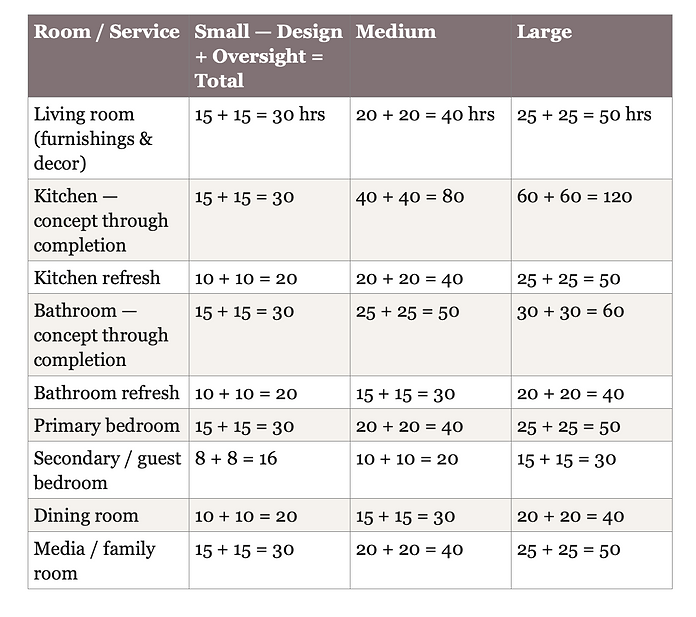
A note before these numbers: the hours below are rough averages only — planning guides, not hard numbers.
Every project is unique. Yours may take more time or less depending on its nuances — the scope, the decisions already made, how many trades are involved, and how quickly selections come together. I will always tell you honestly where your project stands relative to these ranges.
Most of my clients engage me for the full process: the design work, the oversight, procurement, and execution. So each line below shows both, plus the total.
So a realistic example: a medium-sized bathroom, designed fully and executed with my managing the process, is roughly a 40-hour engagement. Multiplied by my hourly rate, you can plan for design time the same way you plan for tile.
PART THREE: YOUR FURNITURE BUDGET
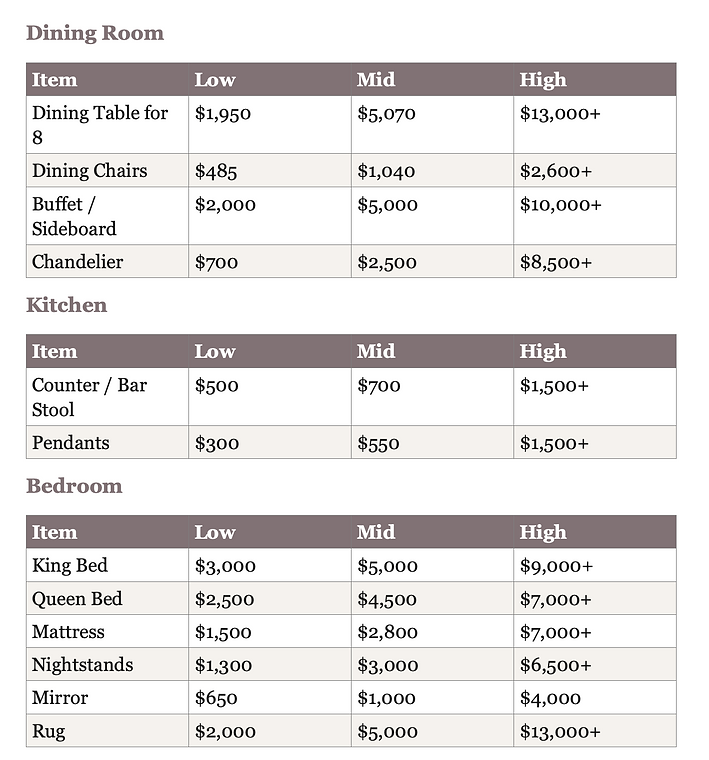
The numbers that follow show typical investment ranges for the furniture and decor items clients ask about most often. They're meant to help you orient — to locate yourself before we ever talk numbers. Wherever you find yourself in these ranges, my job is the same: to bring you the best possible value and a home you love.
These amounts are not exact — they're meant to give you a ballpark of what to expect. Amounts can go lower (or higher) depending on where we source furniture and related items.
*A good rule of thumb is to note that overall, fully finished decor generally starts at about 20% of the home value and can go up from there. Finished decor includes furniture, rugs, wallpaper, soft furnishings (window coverings, bedding, pillows) and accessories. This percentage does not include design hours, construction, or associated construction costs.
PART FOUR: HOW WE STAY ON THE SAME PAGE
-
Itemized invoices — my invoices arrive monthly, itemized by date and task — you'll always see exactly where your hours went.
-
Clear fees — all fees — hourly rate, finder's fees, purchasing — are spelled out in my service agreement before we begin.
-
A live project document — your selections, plans, and notes grow with your project; you can see the work as it accumulates.
-
Flexible pacing — at any point, we can talk about pacing — smaller scopes, room by room, or specific tasks only. My job is to bring you the most value from every hour and every dollar we invest together.
Beauty doesn't happen by accident. It's planned, budgeted, and built — with purpose.